

Attention Seeking B*tch
Why being an attention-seeker makes me better at producing outstanding cyber security training. Let’s get the title out the way first. I’ve been called an attention-seeker most of my adult life. Sometimes it’s affectionate. Sometimes it’s a joke. Sometimes it’s…

Why being an attention-seeker makes me better at producing outstanding cyber security training.
Let's get the title out the way first.
I've been called an attention-seeker most of my adult life. Sometimes it's affectionate. Sometimes it's a joke. Sometimes it's said with the full intent of landing as an insult and staying there. I've never bothered correcting it. Not because I enjoy the label, but because it's accidentally accurate in the way that matters most.
That trait is one of the biggest reasons I'm good at designing cyber training that actually works.
Not because I need to be seen. But because I understand attention. And attention, whether the industry likes it or not, is the foundation of behaviour change.
Cyber security has spent decades mistaking information for influence. We document risks, publish policies, roll out awareness modules, then act surprised that people ignore them. Meanwhile, the real problem isn't ignorance. It's indifference. People don't fail at cyber because they're stupid or reckless. They fail because nothing about the way we teach security competes with the rest of their working lives.
Attention isn't a nice-to-have. It's the entry fee.

The human brain forgets most passive information almost immediately. Click-through training, static slides, box-ticking quizzes all fade before they've had a chance to become behaviour. Without emotional engagement, learning has nothing to anchor to. This isn't a theory problem. It's biology. If something doesn't register as meaningful, urgent, or human, the brain quietly discards it.
This is where people start muttering about professionalism.
Because what we often label as "attention-seeking" is actually something far more useful: pattern disruption. The ability to interrupt autopilot. To break the rhythm of corporate monotony long enough for a message to land. Humans remember what feels different. They remember tension, surprise, humour, embarrassment, urgency. They remember moments where something went slightly wrong and they had to think.
They do not, dear reader, remember slide forty-seven.
In behavioural science, novelty and emotion are not gimmicks. They are memory triggers. Experiences that disrupt expectation create stronger recall because they demand cognitive effort. That’s why interactive, story-driven formats consistently outperform passive instruction. Not because they’re fun, but because they force engagement.
This is also why cyber training needs more energy, more drama, and frankly, a little more chaos.
Cyber risk is emotional in real life. Breaches are stressful. Social engineering is manipulative. Mistakes feel personal. Yet we teach security as if removing all emotion somehow makes it safer. What we end up with is training that feels sterile, distant, and completely disconnected from how incidents actually unfold.
People don’t change behaviour because they were informed. They change because something made them feel exposed, responsible, embarrassed, competitive, protective, or curious. Emotional spikes create stories. Stories get retold. Retelling is how learning spreads beyond the room and turns into culture.
That’s why our escape rooms work. Why SHIFT missions land. Why vishing calls make people uncomfortable in exactly the right way. They generate shared experiences rather than individual compliance. They give teams something to talk about after the session ends, which is where learning quietly becomes normalised behaviour.
Being visible plays a role here too.
There’s a persistent myth that being memorable means being self-centred. In practice, it means being willing to carry the energy so others don’t have to. It means stepping into the awkwardness, saying the thing everyone is thinking, and making a dry subject feel alive. Transformational learning doesn’t happen when the facilitator is desperate to blend into the background.
Cyber doesn’t need more quiet experts hoping people will listen. It needs communicators who understand how humans actually behave under pressure, distraction, and social influence. People who can hold attention without apologising for it.
If you want secure behaviour to stick, delivery cannot be subtle. It has to compete with inboxes, meetings, deadlines, Slack notifications, and the constant hum of modern work. It has to feel worth remembering. Story-based learning, experiential missions, and roleplay work because they create emotional anchors. Those anchors are what the brain reaches for later, when a real decision has to be made.
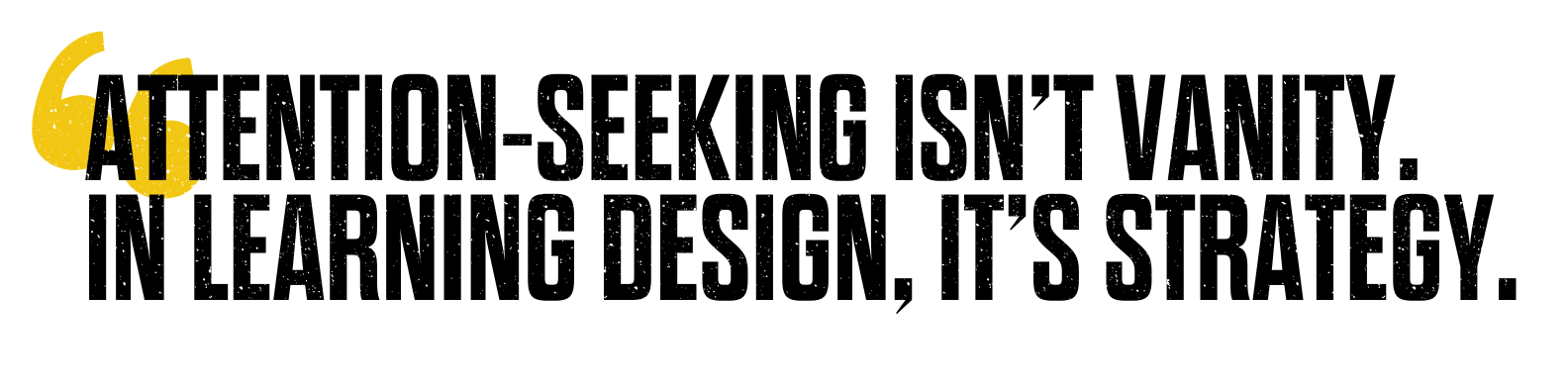
Attention-seeking, in this context, isn’t vanity. It’s strategy.
So no, I’m not sorry for being an attention-seeking bitch.
Humans don’t learn through beige. They never have. They learn through disruption, emotion, repetition, and story. Those just happen to be the tools I’m willing to use loudly.
If that makes people uncomfortable, good.
Cyber training should be.
Stop Training. Start Rehearsing.
See what changing behaviour actually looks like when the stakes feel real.
Book a Session →