

Why everything you teach will be forgotten
Half of what people passively learn is gone within an hour. Not because your people aren't trying. Because the brain is doing exactly what it's designed to do - and passive training is designed to trigger exactly the wrong response.
The Behaviour Cycle White Paper ⋅ Research Series
56%
of passively learned information is gone within one hour. Not by the end of the week. Not by Friday. Within the hour. Without emotional encoding or reinforcement, the brain treats it as clutter and bins it.
Ebbinghaus (1885). Replicated by Murre & Dros, PLOS ONE (2015).
4×
less information forgotten when learners practice retrieval instead of restudying. The act of trying to remember something is more powerful than the act of being shown it again. Immersive scenarios create retrieval loops automatically - every decision is a memory test.
Roediger & Karpicke, Psychological Science (2006). g=0.50–0.61 across meta-analyses.
61%
Of employees fail a basic security knowledge test after completing their mandatory training. Not before. After. The training ran. The knowledge didn't stick. And most of them felt confident they'd pass.
Epignosis cybersecurity training survey (2023), n=1,200 US employees.
The brain forgets on purpose. passive training helps it along.
Hermann Ebbinghaus mapped this in the 1880s. A 2015 replication by Murre and Dros confirmed his findings still hold. Without reinforcement, roughly half of new information is gone within an hour. By the end of the day, around 70%. Within a week, if the material was emotionally neutral and delivered passively, close to nothing useful remains.
This isn't a flaw in the people. It's the brain doing its job. Memory is not a hard drive. It is a biological system under constant pressure to discard low-priority data and make room for what actually matters. Passive training signals very clearly that it doesn't matter. So the brain obliges.
The forgetting curve is not the industry's enemy. Designing training that ignores it is.

Four reasons your training doesn't survive contact with money morning

The brain deletes within the hour
For something to move from short-term experience to long-term memory, the brain needs a reason to bother. Emotional weight. Active processing. Repetition. Passive delivery provides none of these. So the brain doesn't store it. The material evaporates - often before the learner has even closed the tab.

Clicking next isn't reinforcement
Completing a module is not the same as learning from it. The brain requires spaced retrieval (the act of trying to recall something) to build durable memory. Being shown information again doesn't do it. A quiz at the end of the same session doesn't do it. Answering questions days later, under conditions that resemble the real situation, does.

People think they've learnt. They haven't.
Passive formats create a feeling of familiarity - the sense that something went in - when it didn't. Deslauriers confirmed it: students in passive lectures scored 45% on the same material while reporting they felt they'd learned more than the active group who scored 70%. The training makes people confident. Confident and wrong is worse than uncertain.

One session was never going to be enough
Cepeda et al.'s meta-analysis of 317 experiments confirmed it: distributed practice outperforms a single learning session by 10–30% regardless of the material. The brain needs time between encounters to consolidate. Annual training gives people one encounter, twelve months apart. That is not a learning programme. It is an audit trail.
Testing yourself beats studying. Every time.
Roediger and Karpicke at Washington University ran the comparison directly. Students who restudied material forgot 56% within two days. Students who practised retrieval - actively trying to recall rather than re-read - forgot just 13%. Not a marginal difference. Four times less forgetting, from one change in method.
It's not a one-study finding. Every major meta-analysis that has looked at this (Rowland in 2014, Adesope et al. in 2017) found the same result across every subject and age group. Retrieval practice beats every other study method. Every time. The evidence is not ambiguous.
4×
Less forgetting with retrieval practice vs restudy. The act of trying to remember something does more for memory than being shown it again.
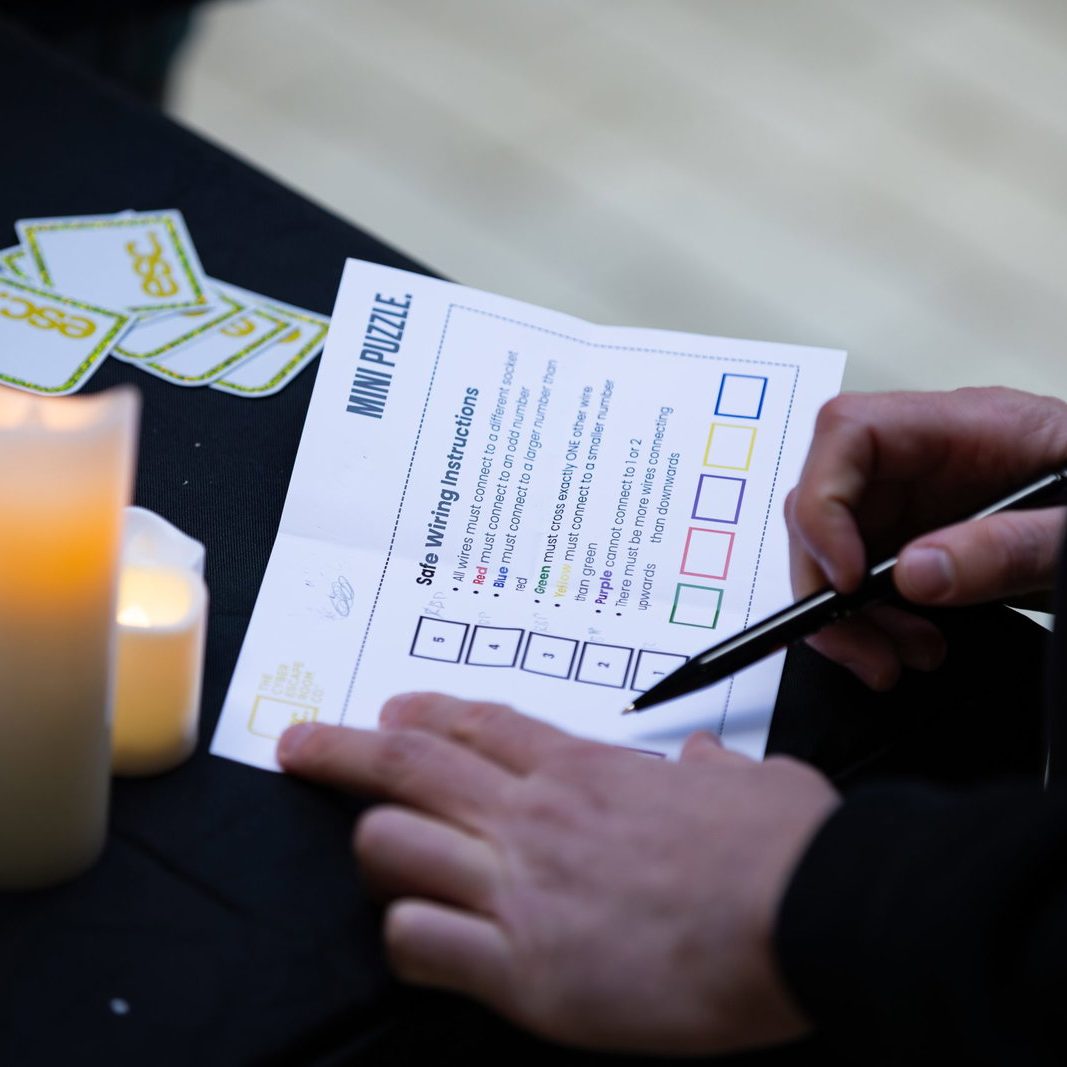
This is why immersive learning works for retention - not just engagement. An escape room isn't just more interesting than a module. It is structurally a retrieval practice environment. Every puzzle requires participants to reach for knowledge, apply it under pressure, and see the consequence. That loop is what the brain needs to hold onto something.
Space it out and the effect compounds. Cepeda et al. reviewed 839 separate assessments and found that spreading learning across multiple encounters - rather than cramming it into one session - improves retention by 10–30%. The gap between sessions is doing work. It gives the brain time to consolidate. Annual training gives people one session every 365 days. That's not a programme. That's a calendar event that generates a completion email.
A note on a statistic you've probably seen
The claim that "we remember 10% of what we read and 90% of what we do" has no empirical basis. Edgar Dale's original Cone of Experience contained no percentages at all - they were added later by people who didn't check. The National Training Laboratories, to whom the numbers are often attributed, cannot produce any supporting research. The figures vary between versions and their suspiciously round numbers signal fabrication, not measurement.
Don't cite them. The real evidence is more than strong enough without them — and citing made-up statistics in a serious argument undermines everything around them.

- Ebbinghaus, H. (1885). Über das Gedächtnis. Reprinted as Memory: A Contribution to Experimental Psychology (1913).
- Murre, J.M.J. & Dros, J. (2015). Replication and Analysis of Ebbinghaus' Forgetting Curve. PLOS ONE, 10(7).
- Roediger, H.L. & Karpicke, J.D. (2006). Test-enhanced learning. Psychological Science, 17(3).
- Karpicke, J.D. & Roediger, H.L. (2008). The critical importance of retrieval for learning. Science, 319(5865).
- Rowland, C.A. (2014). The effect of testing versus restudy on retention. Psychological Bulletin, 140(6). Mean effect size g=0.50.
- Adesope, O.O. et al. (2017). Rethinking the use of tests. Review of Educational Research, 87(3). Mean effect size g=0.61.
- Cepeda, N.J. et al. (2006). Distributed practice in verbal recall tasks. Psychological Bulletin, 132(3). Meta-analysis of 839 assessments.
- Deslauriers, L. et al. (2019). Measuring actual learning versus feeling of learning. PNAS, 116(39).
- Epignosis (2023). Cybersecurity training survey. n=1,200 US employees.
- Masters, K. (2013). Edgar Dale's Pyramid of Learning in medical education. Medical Teacher, 35(11).
Find out where your programme is losing people.
The Behaviour Cycle Check takes three minutes. It tells you exactly which stage you're skipping - and what to do about it.