

Awareness Is The Outcome
Awareness is treated like a task to be completed, measured, and filed away. But real awareness doesn’t arrive on a schedule or live inside a dashboard. It shows up later, under pressure, as recognition, hesitation, judgement. And if it’s not…

Awareness is treated like a task to be completed, measured, and filed away. But real awareness doesn't arrive on a schedule or live inside a dashboard. It shows up later, under pressure, as recognition, hesitation, judgement. And if it's not there when it matters, the work never really happened.
We keep saying "awareness" as if it's something you can run like a meeting, schedule like a webinar, or tick off with a completion certificate. And a mild sense of relief that it's finally "done". Then cyber awareness month comes round. And so the posters go up. And the emails go out. And our LMS lights up like an overly-festooned Christmas tree with modules that promise thirty minutes of compliance-friendly calm. Somewhere, a dashboard fills with green ticks. And yet nothing actually changes.
That’s because awareness is not an activity. It never was.
Awareness is an outcome. It's what's left behind after something meaningful has happened. It is the residue of experience, not the product of instruction. You don't become aware of fire because someone showed you a diagram of a flame. You become aware because you've felt the heat, smelled the smoke, or stood close enough to know that this thing demands some respect. Everything else is just vocabulary.
Let's face it, if awareness alone were enough, we would have solved this problem years ago. People know the rules. They know passwords should be strong, that phishing exists, that attackers manipulate emotion, that security is "everybody's responsibility". This isn't groundbreaking stuff. None of this knowledge is rare. None of it is secret. And yet, breaches keep happening not because people are ignorant, but because knowledge is fragile under pressure and behaviour is shaped far more by context than policy.

The moment that things go wrong is very rarely a moment of stupidity. It is a moment of speed, or trust, or distraction, or fatigue. It's 4.47pm on a Friday and the message sounds right, looks urgent, and claims authority just convincingly enough that slowing down feels more risky than pushing through. In that moment, awareness as information is useless. What matters is recognition.
And recognition only comes from experience.
This is where most so-called awareness programmes quietly fail. They teach people what attackers do, but they never show people what it feels like to be targeted. They explain the theory of manipulation without recreating the conditions under which manipulation works. They assume that knowing the answer in a safe, abstract setting (oh yes, the training room!) will somehow override instinct when the stakes are real, the kids are driving you nuts, you're boss needs that report in the next hour, and you're hungover.
Newsflash... it doesn’t.
The human brain does not prioritise information because it is correct. It prioritises information because it is meaningful, emotional, and anchored to memory. That’s why people can remember that time they got lost in the supermarket as a kid in vivid detail years later, yet forget an entire training session before they’ve even closed the tab. One mattered. The other merely occurred.
We’ve built an industry around broadcasting guidance and calling it change. Posters. Videos. Quizzes. Annual refreshers. All technically accurate. All meticulously logged. All largely interchangeable. All part of the Slides'n'Quiz™ compliance theatre production: expensive, performative, and quietly useless. Communication is mistaken for transformation, and awareness is treated as something you deliver rather than something that emerges.
Real learning works the other way round.
It puts people inside the problem instead of standing them in front of it. It forces decisions rather than asking for agreement. It creates uncertainty, tension, consequence. It allows people to make a call, follow a path, trust the wrong thing, and then sit with the result long enough for the lesson to stick. Not in a shaming way, but in a human one. This is how pattern recognition is built. This is how judgement sharpens.
Only then does awareness appear later, unannounced, in the real world. It shows up as a pause before clicking. As a flicker of doubt when a message feels almost right. As the instinct to ask a colleague rather than powering through alone. As the quiet recognition that something doesn’t add up, even if you can’t immediately explain why.
That pause is the outcome everyone claims to want. But it doesn’t show up neatly on a dashboard, it doesn’t prove its value on demand, and it refuses to arrive on a reporting cycle. So it’s politely admired and practically ignored.
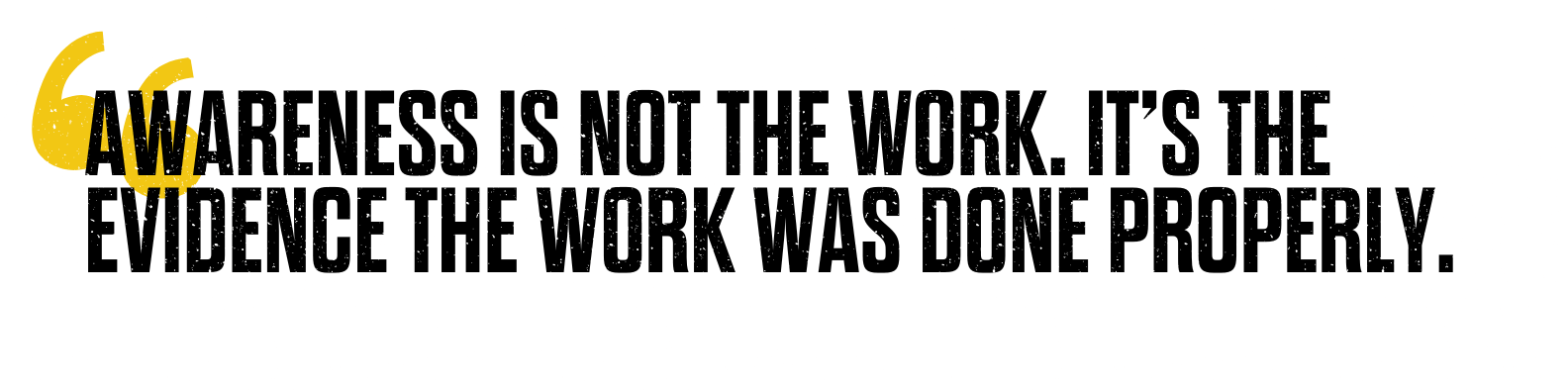
Awareness is not the work. It is the evidence that the work was done properly.
Stop Training. Start Rehearsing.
See what changing behaviour actually looks like when the stakes feel real.
Book a Session →