

Give Your Champions Something Worth Championing.
You've done the hard part. You've identified the right people, given them the title, and asked them to shift the culture of an entire organisation. The part most programmes skip: giving them the tools to actually do it.

Champions networks stall because champions have nothing to do.
Security champions programmes are a genuinely good idea. Take your most engaged people, give them a role in shifting the culture, and let peer influence do what top-down communication never could. In theory, it works.
In practice, most champions programmes hand people a title, a badge for their email signature, and a vague instruction to "raise awareness." Then everyone wonders why engagement drops off by month three.
The problem isn't the people. The champions are often the most motivated individuals in the organisation. The problem is that there's nothing for them to run with. No mechanism. No shared language. No experience they can point to and say: this is what we're here for.
A champions network without something to champion is just a distribution list with better branding.
What changes the equation is giving champions a programme with real substance. Experiences their colleagues actually want to take part in. Moments that create shared language. Content that doesn't require a communications degree to deliver.
That's where we come in.
Earn attention. Nothing else works without it.
Normalise behaviour. This is where champions live.
Make it automatic. The goal the whole system is pointing at.
Champions are your culture layer.
The Behaviour Cycle runs in three stages: Engagement, Culture, Instinct. Awareness is the outcome of all three working together, not a stage in itself and not something you can shortcut to.
Champions don't sit at the start of that chain. They sit in the middle, and that's where the real work happens. Engagement creates the spark. Champions sustain it. They hold the shared language between sessions. They create the conditions where good behaviour stops feeling like training and starts feeling like how things work around here.
But to do that, they need experiences worth reinforcing. Give them flat content and they've got nothing. Give them something genuinely worth talking about, and the culture layer runs itself.
Every product. One job. All of them built for champions.
Each product in The Cyber Escape Room Co. ecosystem serves a distinct role in the Behaviour Cycle. Champions don't need to use all of them. But every one of them is designed to slot into a champions-led programme without creating delivery overhead.
A high-energy, tactile experience that creates immediate emotional buy-in and gives the whole programme a credibility it doesn't get from a poster campaign. Something colleagues genuinely want to take part in.
Champions are trained to run sessions peer-to-peer via our train-the-trainer approach. They facilitate on their floor, in their team, at their pace. No external delivery required once the programme is established.
Scale without delivery burden. Champions can push SHIFT scenarios to remote teams, distributed offices, and colleagues who can't make a physical session, keeping the programme consistent across the whole organisation.
Champions share access, track completion within their team, and use post-session conversations to reinforce what colleagues experienced. SHIFT does the facilitation. Champions do the follow-through.
A novelty-driven experience that meets people in the moment and breaks the pattern of "another training thing." AR creates the kind of genuine curiosity that champions can point to when building the case for continued engagement.
Champions activate ALT for team events, lunch-and-learn sessions, or awareness month activations. Designed for group delivery without specialist technical knowledge. Scalable across sites.
Real pressure testing for the roles attackers actually target. Champions are often closest to the colleagues most at risk. CTRL+Vish gives them a way to identify gaps and build confidence in the general workforce without a blame culture attached.
Champions flag high-risk individuals and teams to the security function, helping to target simulations where they matter most. They also provide the safety net: familiar faces who can debrief colleagues after a live simulation without it feeling punitive.
A moment that makes the whole programme visible. SPACE_ is the flagship activation, usually anchored around October. It signals to the entire organisation that this programme is real, it matters, and it's different to anything that came before it.
Champions are the engine of the build-up. In the weeks before a SPACE_ activation, champions create intrigue, drop hints, and use peer influence to drive footfall. The experience spreads the way all good things do: through conversation, not communication plans.

"Everyone enjoyed doing the escape rooms and we had so much positive feedback. It brought to life how good security hygiene is so important, and made everyone think about how they can put this into action daily."
Cyber Culture Lead, Admiral Insurance
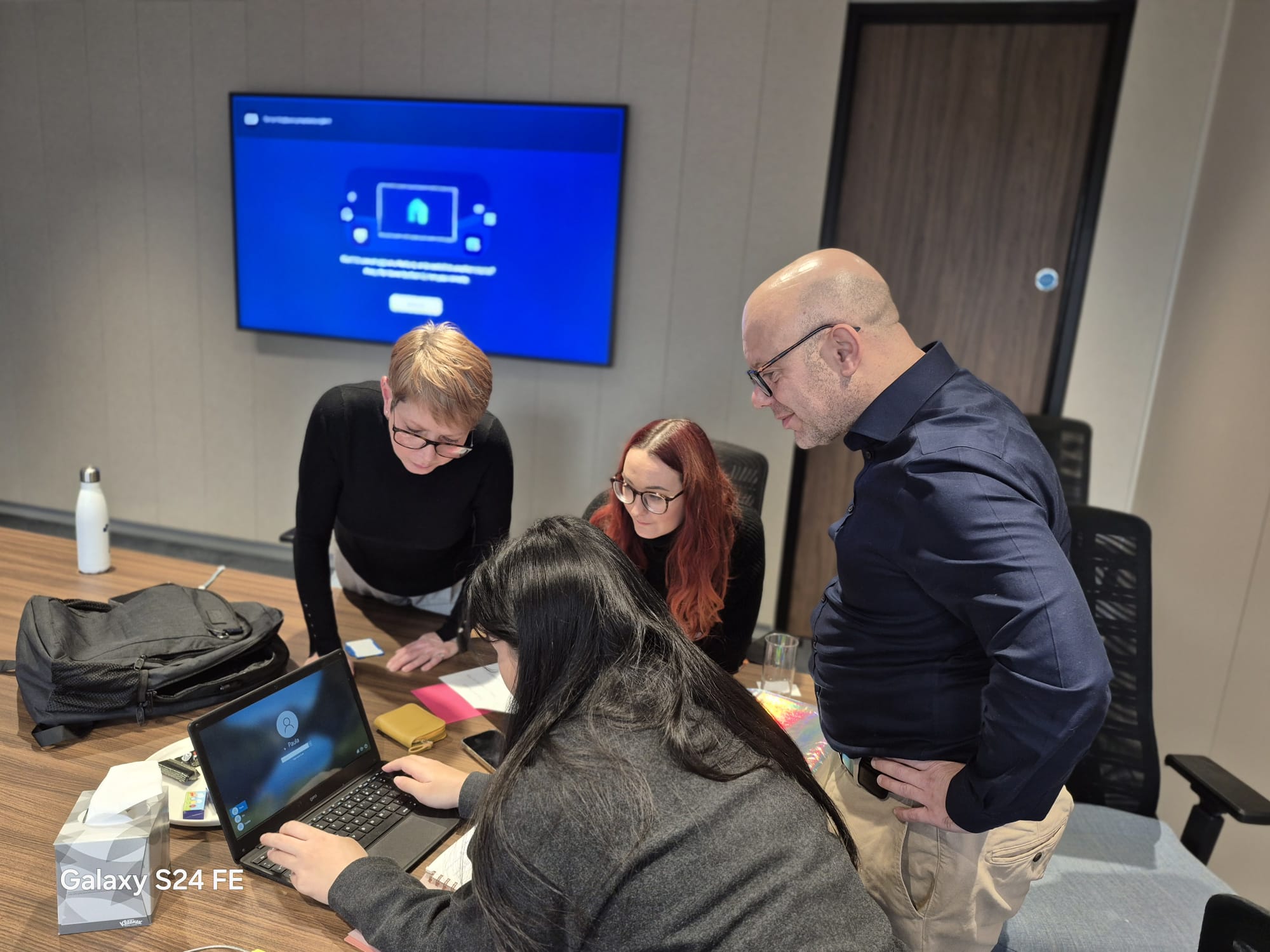
We train your champions. Then we get out of the way.
The goal isn't a programme that depends on us to deliver it. The goal is a programme that runs inside your organisation, led by your people, and grows as your champions network does.
With our train-the-trainer component, we work directly with your champions, building their confidence and capability to run sessions themselves. We establish the format, the facilitation approach, and the debriefing structure. Then we hand it over.
What train-the-trainer covers
Champions learn how to set up and reset the kit, how to facilitate a session without prior security expertise, how to debrief effectively, and how to handle the moments where a colleague's reaction suggests a bigger conversation is needed.
It is not a train-the-trainer programme designed to make people feel like facilitators. It is a practical handover designed to make the programme self-sustaining.
Scenario rotation keeps it fresh
Scenarios rotate quarterly. That's not a product feature, it's a programme design decision. Champions can't sustain engagement with the same experience twice. New scenarios give them something new to offer, a reason to run another session, and proof that the programme is alive rather than a one-off initiative that ran out of steam.
Scenario options in the ESC library, rotating quarterly. The Break In, The Breach, The Heist, and Elementary. Each one covering different threat areas and risk behaviours.
Ways champions can activate the programme beyond running sessions. OSINT challenges. Broadcast messages. Pre-event recruitment campaigns. Champions are the engine of the build-up, not just the delivery.
Security expertise required to run a session. Champions are trained to facilitate. The experience creates the learning. Their job is to hold the room, not to teach cyber security.
A champions programme that actually runs.
Most champions programmes die because they rely on goodwill and good intentions. Both run out. A programme built on The Cyber Escape Room Co. ecosystem doesn't need goodwill. It needs champions who have something worth showing up for.
Here is what the programme looks like when it is working properly.
Champions run regular sessions without requiring central coordination or external facilitation.
Colleagues request to take part rather than needing to be prompted, chased, or mandated.
Security conversations happen naturally in team meetings, Slack channels, and in the moment, not just in formal training slots.
Remote and distributed teams access the same quality of experience via SHIFT and ALT, with no delivery gap between HQ and field.
October awareness month is a moment the organisation looks forward to, anchored by a SPACE_ activation that champions have been building towards for weeks.
Champions have something to show the board: participation data, behavioural signals, and a programme narrative that holds up to scrutiny.
The programme grows as the champions network grows. New scenarios, new products, new cohorts of champions, without needing to rebuild from the ground up.
Ready to give your champions network some teeth?
We'll talk through where your programme is right now, what your champions are working with, and what a sensible place to start looks like. No pitch deck. No pressure.