

The board is going to ask what changed.
You ran the programme. You’ve got the attendance figures. Nobody in that room wants attendance figures. Instinct Lab measures the decisions your people make before and after they rehearse, and shows you whether the number moved.
Two numbers. No hiding.
Completion tells you who turned up. It tells you nothing about who would pause before clicking, question the call, or report the thing that felt off. Instinct Lab measures that instead, and puts it in two numbers from 0 to 100.
What your people would actually do
When it matters: spot the threat, make the safe call, report it. Built from scenario questions and real-life recall, not from asking people how secure they feel.
How they behave, day to day
Scored across five secure behaviours. Self-ratings count for less, because they flatter. When your people play SHIFT, run a CMD exercise or take a CTRL+VISH call, what they did feeds in too.
Every score sits in one of four bands: Reactive, Developing, Embedded or Instinctive. Instinct Lab also shows what your engagement, awareness and culture would predict your SII to be, next to what your people actually showed. When the two disagree, that’s worth knowing.
Knowing what your people can actually do is getting harder. The NCSC thinks it’s likely organisations “will lose sight of their workforce’s competency in cyber security if the tasks are frequently outsourced to shadow AI”.
NCSC Annual Review 2026
Measure. Rehearse. Measure again.
Anyone can show you a score. We show you a score that moved, then show that the rehearsal is what moved it. Same questions, same people, a dated gap in between.
Baseline
Before you start, a staff survey and an exec survey set your starting position: where instinct is strong, where it’s exposed, and how far apart the boardroom and the floor really are.
Rehearse
Your people run a real experience: an escape room, a SHIFT mission, a CMD exercise, a CTRL+VISH call. They make decisions under pressure, and those decisions become evidence.
Measure again
14 to 28 days later, we measure again against the same locked questions, so the comparison is fair. The change is real, it’s dated, and it’s yours to show.
The board and the floor disagree.
Ask the exec team how safe the place feels. Then ask the person who answers the phones.
The two answers rarely match. Until you’ve measured both, you don’t know how far apart they are in your organisation, and that distance is the difference between the risk you think you’re carrying and the risk you actually are.
Instinct Lab surveys staff and leaders, then sets the leaders’ view of your people against what your people actually showed, term by term and behaviour by behaviour. Each gap is marked from aligned through to material misalignment.
Close it and everything downstream gets easier: people report sooner, speak up faster, and trust that the right call gets backed.
Five behaviours. Not a score.
A single index is useful in the boardroom and useless in the corridor. Underneath it sit five behaviours that decide whether a real incident gets caught or gets through, each scored on its own, with your weakest called out.
Risk recognition
Does the invoice that arrived at 4.55 on a Friday feel off, or does it just feel like Friday?
Secure decisions
When the quick option and the safe option aren’t the same option, which one wins under a deadline?
Reporting
Do people tell someone when they’ve clicked, or wait to see if anything happens?
Authentication and credentials
Passwords, MFA prompts, and the shared login everyone knows about and nobody mentions.
Psychological safety
Can a junior say “I’m not doing that” to a senior on the phone, and expect to be thanked for it?
Say it. Do it. Get seen doing it.
One source never tells the truth on its own. A survey says your people would report a suspicious call. A CTRL+VISH call finds out whether they do.

Surveys
Short staff and exec surveys, built around situations rather than definitions, with awareness questions that have a right answer. Ten minutes on a phone, not an hour in a classroom. They set the baseline and re-anchor the score each time you measure again.
The experiences
Every decision made under pressure in SHIFT, CMD and CTRL+VISH flows in between surveys, and every rehearsal shows up on a year view of your organisation’s practice.
Facilitators
Behaviour seen in the room during live escape rooms, recorded by the people running them, as its own number alongside the others. The hardest evidence to argue with. We’ll tell you when it’s live rather than pretend it already is.
The Behaviour Formula
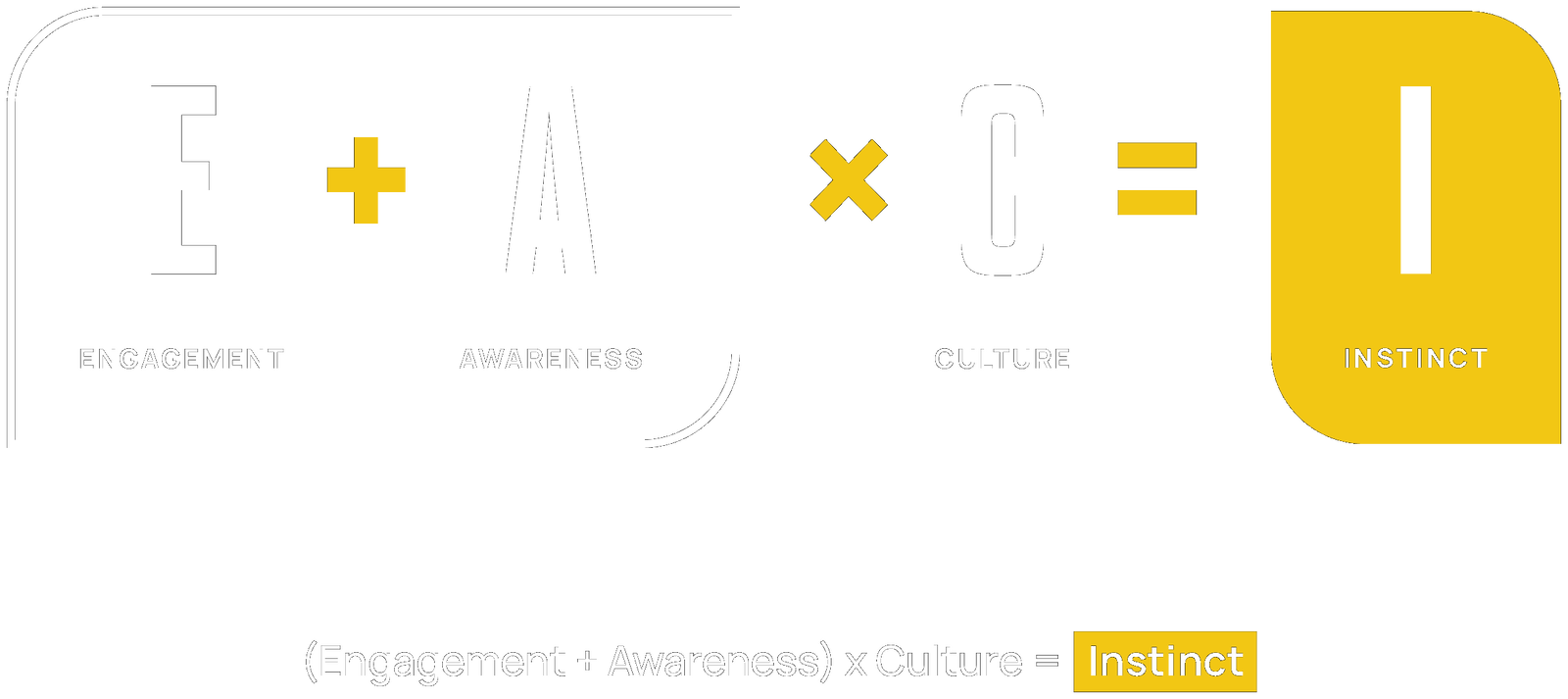
Engagement and awareness sit inside the bracket, and they’re what every programme already works on. Culture sits outside it because it doesn’t add to the result, it multiplies it.
A strong culture carries people beyond what they’d manage alone. A weak one drags a well-trained team back to guessing. So it’s the one term that can sink the whole equation, and the one we treat as a multiplier rather than a score.
Engagement
Are people actually present, or clicking through to get back to work?
Awareness
Do they recognise the threat when it’s in front of them? Tested, not self-rated.
Culture
Will the organisation around them back the right call? Applied as a multiplier.
Instinct
The output: your Security Instinct Index.
Take it to the board in their language.
Instinct Lab drafts a board report from your scores: the finding, the numbers at a glance, your strengths and priorities, and what to do next. Edit it, then download it as a PDF.
Boards and executive teams should seek assurance not only that policies exist, but that they can demonstrate measurable improvements in preparedness.
NCSC Annual Review 2026
Each of the five behaviours is mapped to the controls behind the frameworks your auditors already use, so a behavioural score turns into something an audit committee recognises.
Instinct Lab indicates behavioural alignment with the referenced frameworks at a control level, reviewed against current published versions. It is not a compliance assessment, audit or certification, and it does not guarantee any regulatory outcome.
It sits underneath the experiences.
Instinct Lab is where our experiences report back. Run them, and the decisions your people make land in one place, next to your surveys and your board report.
SHIFT
Every decision in every mission is scored into the Lab.
Explore SHIFTCMD
Live crisis rehearsal for leadership, with calls landing on real phones.
Explore CMDCTRL+VISH
AI callers find out whether people hang up or hand it over.
Explore CTRL+VISHESC
Hosted or self-run, with the kit, the people and the surveys managed in the portal.
Explore ESCFind out where you’re starting. Then move it.
Start with a baseline of where your people’s instinct sits today. Rehearse. Measure again. We’ll walk you through the loop and show you the platform on the call.