

The Behaviour Formula.
The formula behind the only security outcome that matters: what people actually do when it counts.
Human risk isn’t a people problem. It’s a design problem.
When someone clicks a phishing link or works around a control, the instinct is to blame the person. But the person did exactly what their environment set them up to do.
The failure wasn’t human. It was in the design. And a design problem isn’t fixed by running another campaign. It’s fixed by solving the formula.
Two inputs in sequence. One multiplier. One output.
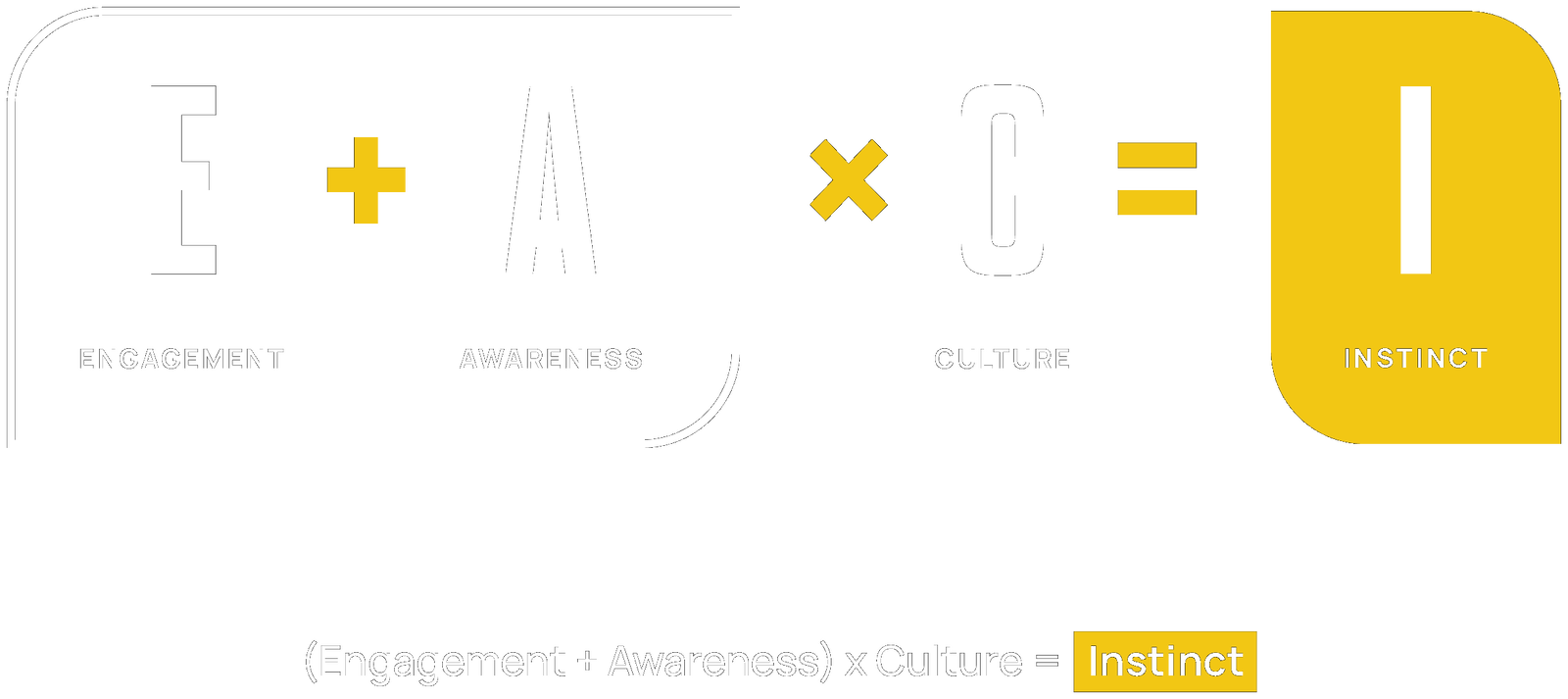
Engagement earns attention. Awareness lands because attention exists. Culture multiplies whatever the first two produce, and instinctive behaviour is what comes out the other side.
Notice culture sits outside the bracket. That’s deliberate. Weak engagement starves awareness, and weak awareness leaves nothing to embed, but culture is the only term that can take everything you’ve built and multiply it by zero.
Not a loop. Not a maturity model. A formula. And formulas can be solved.
The industry has been solving for the wrong variable.
96% of people who took the risky action knew it was risky. So what’s actually missing?
Proofpoint, State of the Phish 2024
For twenty years the answer to human risk has been the same: modules, posters, phishing tests, October campaigns. Push the knowledge out, prove it was delivered, and hope behaviour follows.
It doesn’t. Proofpoint found that 96% of employees who took a risky action knew it was risky when they took it. The knowledge is already there. The behaviour isn’t. So why does the industry keep buying more knowledge?
Because something must be done, and awareness is something. The success question shifts from “did anyone do anything differently?” to “did everyone click through?” And when behaviour still doesn’t move, the blame slides onto the people. They didn’t pay attention. They don’t care enough.
That’s where programmes stop being ineffective and start doing harm. Phishing simulations become traps. Reporting drops. Questions stop. People don’t become more aware, they become quieter, and silence is one of the most dangerous states an organisation can be in.
The problem isn’t the people. It’s the formula. Awareness isn’t the outcome, it’s one term in the equation. Solve it in the wrong order, or multiply it by a hostile culture, and the output doesn’t change, however much you spend on the inputs.
Engagement.
Nothing in this formula works without engagement. Not awareness, not culture, not instinct. If people aren’t paying attention, everything downstream is expensive noise.
Engagement isn’t about making training fun. It isn’t gamification, novelty for its own sake, or a branded e-learning module with a character called Cyber Sam. Engagement is genuine attention and emotional signal. Without those two things the brain doesn’t bother encoding what it’s shown. Information arrives, gets filtered out, and nothing changes.
That’s biology, not opinion. The brain prioritises emotion, novelty and relevance, and deprioritises everything else. Ebbinghaus found that more than half of newly learned material is gone within an hour, and the finding has held up when it’s been repeated. Clicking next isn’t learning. It’s compliance theatre with a progress bar. Ebbinghaus 1885; Murre and Dros, PLOS ONE 2015
Attackers understand this completely. Social engineering works because it triggers attention, urgency and emotion with precision, while the training meant to stop it is delivered in formats almost designed to be ignored.
That’s why experiential learning works. Not because it’s more enjoyable, though it often is, but because it creates conditions the brain treats as real: shared pressure, and decisions that matter just enough to be remembered.
Engagement earns attention. Attention is what makes the next term possible.
Awareness.
Here’s something you might not expect from us: awareness matters. People do need to know what good looks like, what a pretexting call sounds like, and why the urgent invoice that arrived at 4:58pm deserves a second look.
Caring about awareness wasn’t the industry’s mistake. Treating it as the destination was: the thing you deliver, measure and declare done.
Awareness is a payload, and a payload needs a delivery mechanism that works. In one well-known study, students who simply reread material had forgotten 56% of it two days later. Students who had to recall it forgot 13%. Same material, same time. What changed was what the brain was asked to do with it. Roediger and Karpicke, Psychological Science 2006
Awareness doesn’t fail because people can’t learn. It fails because it’s almost always delivered without engagement. The bracket runs one way: attention first, knowledge second.
Engagement creates the conditions. Awareness fills them.
Culture.

Culture sits outside the bracket because it isn’t a stage you complete. It’s the number everything else gets multiplied by.
Culture is what people do when nobody is watching. It lives in how leaders respond when something goes wrong. In whether reporting a near miss is welcomed or met with a frown. In whether the security team is known as the people who help or the people who catch you out. In whether mistakes are treated as data or as personal failure.
Those signals are sent constantly, whether the organisation means to send them or not, and people read them with extraordinary accuracy. If the environment punishes visibility and rewards staying quiet, people will be quiet. They stop reporting, stop asking questions, stop flagging the things that feel slightly wrong.
Fear-based messaging doesn’t create security culture. It creates performance. People perform compliance for as long as they’re being observed, and the moment the pressure drops, behaviour snaps back.
The best engagement and the sharpest awareness programme in the world, multiplied by a culture of fear, equals zero. Not reduced. Zero.
Culture multiplies everything inside the bracket. Or it zeroes it.
Multiply by your culture.
Say your engagement and awareness are genuinely good: 82 and 76 out of 100, a bracket worth 79. Now drag the culture multiplier and watch what happens to the only number that matters.
A healthy culture pays out everything the bracket earns.
Instinctive behaviour.
What does a security programme look like when it’s worked? Not rules followed under observation. Not training recalled under pressure. Not a mental checklist run before clicking a link. Behaviour that no longer takes effort.
Drivers don’t think about checking their mirrors. Surgeons don’t deliberate over sterile technique mid-procedure. The behaviour is embedded deeply enough to run without instruction, under pressure, when tired, when distracted.
Instinct isn’t trained into people. It’s produced. Engagement creates a signal strong enough to be worth encoding. Awareness gives that signal its content. Culture multiplies the result until the right behaviour feels like the obvious thing rather than the cautious thing.
Attackers don’t wait for people to be alert and prepared. They engineer the opposite: urgency, distraction, fatigue, social pressure, all designed to overwhelm conscious thought. Instinct is the only defence that still works when conscious thought isn’t available. For most people, in most organisations, that’s most of the time.
When instinct exists, security stops being a department and starts being a disposition.
Not quiz scores. Behaviour.
Reporting
The email that gets reported because something felt slightly off, before anyone could say exactly why.
Hesitation
The link that doesn’t get clicked because someone paused half a second longer than usual.
Verification
The request that gets checked instead of actioned straight away, without a policy having to say so.
Escalation
The conversation with the security team that starts early, before the situation has a chance to grow.
Quiet, consistent and invisible on a completion dashboard. Which is how you know it’s real.
Design the conditions. Instinct follows.
Find out which term of your formula is failing. The Behaviour Formula Check takes about three minutes and shows you where to start.