

Plan October. Don’t just fill it.
October is your best shot at real behaviour change. Our free planner pulls the whole month into one place: set the purpose, map the activity, name the owners and work out what happens next.
Completion is easy. Behaviour change takes more thought.
Real change won’t come from wheeling out the same tired slide deck, or spending thousands on a “cutting-edge” (boring AF) e-learning module.
You might already have vishing exercises, events, resources, leadership support and a comms plan. Great. Now make them mean something. The planner helps you connect every activity to the behaviours and risks that matter, instead of launching a month of disconnected content and calling the job done.

Ten sections. The whole campaign.
Not an empty October grid with a logo at the top. The planner walks you through the whole campaign, start to finish.
Campaign objectives
Get clear on what you want October to achieve before you start booking activities.
Priority behaviours and risk areas
Pick out the actions and threats that matter most to your organisation and your people.
Activity planning
Map events, exercises, sessions and resources across the month, without cramming everything into week one.
Internal comms
Decide what needs saying, when it needs to land and which channels you’ll use.
Leadership involvement
Plan where visible senior support gives the campaign more weight and reach.
Key milestones
Set the dates that matter: approvals, bookings, launches and delivery deadlines.
Ownership
Give every task a named owner, so nothing disappears into the organisational void.
Engagement tracking
Decide how you’ll measure engagement and improvement, not just completion.
End-of-month review
Capture what worked, what fell flat and what your people still need help with.
Beyond October
Turn one busy month into the start of a longer programme.
Start before October.
A few days before is too late. The 1st is launch day, and awareness needs building well before it.
Starting early matters even more if you want something immersive. Escape rooms, vishing simulations and bigger experiences need time to scope, book and build.
A panicked email in late September is not a project plan.
The planner gets you answering these early:
- 1What are we trying to change?
- 2Which behaviours matter most?
- 3Who needs to be involved?
- 4What activities are we going to run?
- 5What needs booking or creating?
- 6Which comms need preparing?
- 7How will leadership be involved?
- 8How will we know it worked?
What will you actually do?
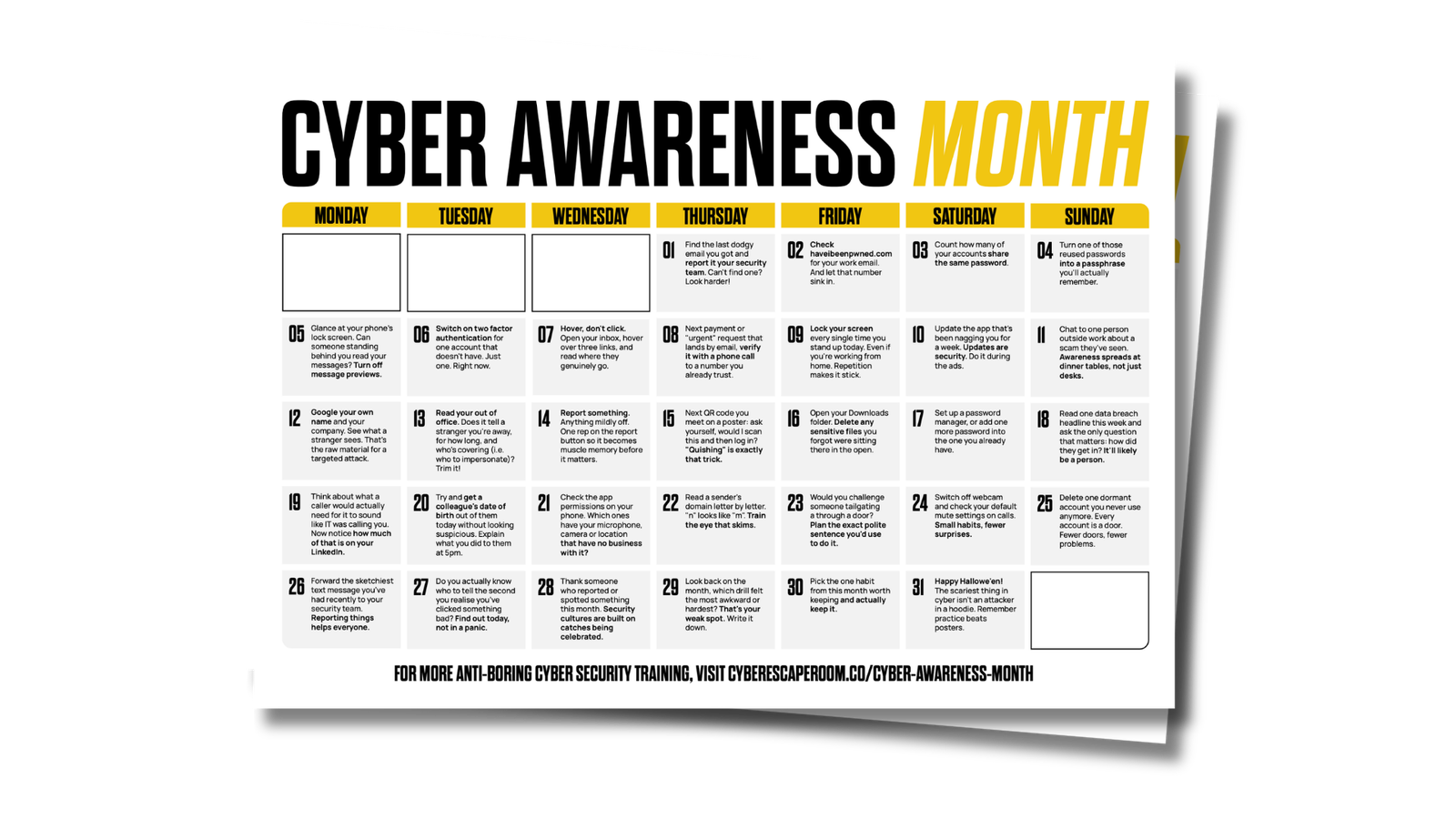
Our 31-day calendar gives you a short, practical two-minute drill for every day of October.
Use the calendar to choose the activities. Use the planner to decide where they fit, who owns them and what each one is meant to change.
Get everyone on the same page.
Who owns each activity
One named person in charge of moving it forward.
Who approves comms
Find your approvers early, not the day before launch.
Who delivers
Who’s running, hosting or facilitating each activity.
Which teams are involved
Where security, learning, internal comms, HR and others need to work together.
When leaders contribute
Give senior leaders enough notice to record messages, turn up or back the campaign visibly.
What has to happen first
The bookings, content, tech, approvals and logistics that delivery depends on.
Don’t let October end on the 31st.
Cyber Security Awareness Month should build momentum, not spike and vanish until next year.
Use what you learn to shape the next thing you do, not just a cheerful email about attendance figures. October can start the conversation. A proper programme keeps it going.
- What got the most engagement?
- Which behaviours still need work?
- What did people struggle with?
- What should carry on?
- What should change?
- What happens next?
Get the planner.
Tell us who you are and the planner is yours. Eight pages, ready to print.
How we use your details: privacy notice.
Here’s your planner.
Download it now. Want ideas for what to put in it? The 31-day calendar is free too.